
Anthropogenic Evolution
- Speakers: Gerhard Weber and Philipp Mitteröcker
Even though human beings and mammals share a large proportion of biological traits, the cumulative development of technology, language and culture has led to fundamental changes in our relationships to the environment, to other living beings, and to ourselves. This has influenced, and will continue to influence, how human beings have evolved in the ecological niche they have, to a large part, created themselves.
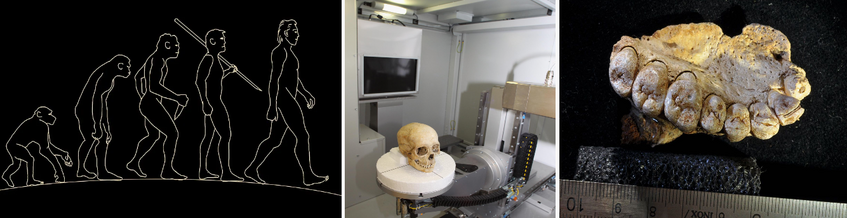
© pixabay
© Gerhard Weber: Inside view of the Micro-CT
© Gerhard Weber: jaw fossil that proves modern humans left Africa up to 60,000 years earlier than initially thought
This key research area focuses on biocultural evolutionary dynamics within the Homo genus, including humanity’s key role in the Anthropocene, by studying the biology and behaviour of human beings in a broad context. This approach includes both theoretical and empirical examinations of how environmental changes as well as socio-cultural and technological transitions have influenced, and will continue to influence, the biology, biography, and health of human beings and other organisms. This research comprises, for instance, the evolutionary interrelations of genes and culture, with the inclusion of palaeoanthropological and archaeological data, and using genomic, medical, demographic, behaviour-related and socioeconomic sources.
Research Groups
| Research Group / PI | Research Topic | Department |
|---|---|---|
| Katerina Douka | Paleoproteomics and Early Human Migration | Evolutionary Anthropology |
| Martin Fieder | Evolutionary Demography, Behavior Genetics | Evolutionary Anthropology |
| Thomas Higham | Archaeological Sciences, Radiocarbon Dating | Evolutionary Anthropology |
| Sylvia Kirchengast | Human Life History | Evolutionary Anthropology |
| Martin Kuhlwilm | Evolutionary genomics | Evolutionary Anthropology |
| Philipp Mitteröcker | Theoretical and Evolutionary Biology | Evolutionary Biology |
| Elmira Mohandesan | Paleogenomics of Roman Equids | Evolutionary Anthropology |
| Ron Pinhasi | Ancient DNA Extraction and Analysis | Evolutionary Anthropology |
| Katrin Schäfer | Human Behavioral Biology | Evolutionary Anthropology |
| Verena Schünemann | Eevolutionary history of Host-Pathogen Interaction | Evolutionary Anthropology |
| Mareike Stahlschmidt | Environmental Ancient DNA Analysis | Evolutionary Anthropology |
| Gerhard Weber | Functional Morphology, Human Evolution, Virtual Anthropology | Evolutionary Anthropology |
| Bernard Wallner | Behavioral Molecular Biology | Behavioral and Cognitive Biology |
| Harald Wilfing | Human Ecology, Anthropological Collection | Evolutionary Anthropology |